Are we there yet? (or road-bock ahead – let’s take another route)

What a period of unpleasant surprises we’ve had recently. In my view they are a combination of causes and effects of the 4th Industrial Revolution. Global warming concerns are driving decarbonisation which is driving energy transition which is driving new technology adoption and resulting in the 4th Industrial Revolution by the back door. It’s not smooth and gradual – external shocks are accelerating and decelerating the process. Not everyone’s happy about it.

There have been a series of large shocks to the economic system. The system that prevailed from 1979 until 2008 no longer functions. The word crisis has been overused. It has not been a single crisis but a series of lurches during a sustained dismantling of a globalised integrated approach that was fuelled by logic and data in what will be seen as a politcally benign period.

I am not going to detail all the main drivers and the minor and major shocks but it’s quite a list. One that includes drivers like digitalisation and information transparency, speculations such as the CDO market (and probably bitcoin), and unplannable events such as Icelandic volcanoes, pandemics, Brexit and a war in Europe.

Almost 10 years ago I started the Bestem journey in pursuit of understanding and helping others cope with the 4th Industrial Age. If you had asked, I would have explained how I believed the rise in technological capability would inevitably result in its adoption. Increased efficiency and the “rise of the machines” would lead to changes to working patterns and force changes in the way wealth was distributed.

You can imagine how disappointed I am that, even with solid business cases in place, companies I talked to resolutely couldn’t have cared less. Certainly not enough to implement change. They were doing just fine thank you and there were more important things to spend their time on. Admittedly I was talking to Oil and Gas operators who exist in a quasi-monopolistic position (where they rarely feel the pressure to compete with each other) but the story was similar in many established industries. Taxi drivers and Hotels were disrupted by Uber and AirBnB – but they were victims of an information revolution rather than an industrial one. If anything, their systems became less efficient, but the profit-distribution changed.

A couple of years ago, I realised that the economic case for solar had dramatically improved. Semi-conductor technology and electrical efficiency had also experienced a step-change improvement. I was sold on the case for energy transition where electrical systems replaced chemical ones based on traditional economic drivers. Of course, I argued, in certain applications where portability of high-density energy was required (air travel etc.) there really were not many alternatives to gasoline available. So, my view was that energy growth would be taken care of through electricity but that fossil fuels would remain the baseload for a while to come.

Then I saw the data on climate change and decarbonisation. I did my research, I read Bill Gate’s book, I watched the BBC series on the obfuscation operations conducted by Big Oil and re-watched Al-Gore’s inconvenient truth from 25 years ago.

I still speak to oil companies that see compliance with environmental legislation and emissions reductions as some form of cost to be managed. It really isn’t. Protecting the atmosphere (or as Al Gore put it, the layer of varnish on top of the globe on your desk – yes it is that thin, and the only thing that makes life possible) is extremely important. It should be our number one priority, it’s a matter of morals not profits. It should be a matter of regulation.

Add to that the evident issues of energy geo-politics and how “western” civilisation and values seem increasingly at odds with the behaviour of “strong-men” leaders who control fossil deposits, and it seems clear that independent, non-centralised, distributed generation and consumption adds resilience that can withstand shocks and provide stable, reliable and fairly priced energy.

We are on the cusp of change in many industries forced by energy scarcity, emissions reduction, supply chain re-configuration, demographics, and work-force expectations. There will be no choice but to adapt to these new configurations, some of which will be underpinned by legislation and international sanctions.

Of course, if you are setting about re-configuring an industry it will inevitably use new information and digital technologies, it will use AI and it will use 3D printing. You might not choose to swap your perfectly functional old system with a slightly better new one, but if you must change anyway then of course you will replace with systems that use the new technologies. These new technologies will be more efficient and will lead to different employment mechanisms and the distribution of wealth.

It’s the same outcome I’ve been banging on about, but it will take a different route.

Change is hard, Business case for survival is hard – screw it let’s cut costs

BA still can’t get operational IT right. The 4th Industrial Revolution has been delayed due to myopic business cases. I suspect BA as a large encumbant in a stagnating industry suffers from this. Fighting climate change will change the calculus and global enforcement of new laws, and what is viewed as acceptable behaviour will require a rethink on spread-sheet optimisation.

When my focus was solely on the digitalisation aspects of the 4th industrial revolution, I wrote a story about BA in 2017 [link], and then again in 2018 [link]. On both occasions I highlighted both how fundamental “Operational Information Technology” was to the heart of the business (rather than a support function) and how “business-case” led decisions had led to bad outcomes.

My friend Krzysztof [link] talks about technical debt  and how, like fast food, it’s occasionally acceptable – but in the long-term will kill you. He speaks of this in the context of software development, but I think it could equally be applied to deferred and missed modernisation opportunities for operational systems.

I thought BA had got the message, and then this:

https://www.theguardian.com/business/nils-pratley-on-finance/2022/mar/31/ba-investors-as-much-as-customers-deserve-explanation-for-it-woes

Change is hard

BA said they would change, and I assume they tried. Just goes to show, change is harder to achieve than it looks. The first step is for leadership to acknowledge that change is required, but implementing that change can be difficult, especially if most of the reason for bad outcomes is their own inability to admit to blind spots. Add to that some bad decision making processes (and possibly some autocratic opinoins) and this is what happens.

Diversity is often talked about but not always understood. Building “Cognitive Diversity” into leadership decisions is challenging, especially when – in order to reach new decisions – the fundamental value decision frameworks need to be challenged. My friend Csaba over at ICQ Global [link] works extensively in this area. If anyone has a line into BA’s management, they might pass on his number.

This is the digitalisation problem. It comes down two factors:              

  • cost justification cases for the SURVIVAL of companies cannot be made due to an inability to demonstrate a return on investment. (daft when you think about it)
  • cases for cutting flexibility and reducing performance on the grounds of cost saving are quickly approved and implemented.

The result is, no digitalisation, no change and a crash course in crisis management. I think this all stems from most “business case” and ROI calculations assuming that the business environment will remain static and everyone will wait around until you can educate senior management and make sense of their digital investment opportunities.

Innovation will be driven by decarbonisation

With the race to decarbonise the atmosphere well and truly on – goals such as electrification and energy transition will impact whole swathes of supply chains.

Digitalisation and the wider adoption of 4th Industrial Revolution technologies will be a prerequisite for survival. The purpose will no longer be to boost short-term profit, but to achieve outcomes that enable companies to survive. It will be interesting to watch how myopic business cases will be overcome.

Perhaps there is a case for saying that financial returns are a hygiene factor and should have a target optimal. Maximisation – for this phase of the transition – should perahaps be focussed elsewhere.

How are you going to hire, train, incentivise and manage the performance of the leaders we now need in place?

Drill Baby Drill……….

Well, I know I said in November that oil prices might spike in the short term, and that we should not discount the prospect of war – but even I didn’t expect $140 oil by March and gas prices up to 800p per therm.

Tragic for those caught up in the mess but for the oil industry it will be profitable in the short run, fill your boots while you can.

Prepare now for the future

But what about the long term? Does it make sense to invest money now when you won’t be reaping the reward until a few years have passed?  Will prices stay up, or will they crash when everyone else who invests comes on stream together?

That dynamic will drive the short- and medium-term market, it’s the classic conundrum of all cyclic markets – lurching from over to under capacity as industry players second guess each other and end up rushing for the exit at the same time. Right now Mr. Putin has just shouted fire in the cinema.

It’s a classic theme that I come across often with my clients. How to balance short term money making with investments that are both speculative and, even when they work, won’t pay off for years. The other position is equally bad – like Wily Coyote running over the edge of a cliff, running fast in the short run looks smart until, one day, it isn’t.

Invest through the crisis

This crisis will be bad, but can lay the foundations for energy security through transition

The industry just got a second window, don’t waste it. Windfall profits can fund transition, which will create the energy security craved by the politicians.

Have a read about energy security, the Russians and the Saudis in my post from 2016 [LINK]

How to think about transition strategy

The clients I work with are addressing energy transition strategy. It’s a hard one for the indsutry veterans because – well old dogs and new tricks. It should be easy right now – but perversly it just got a lot harder . 

In 2014 markets were booming and then suddenly they weren’t as prices fell (due to oil oversupply from shale – or so some thought). Some companies hunkered down and waited for customers to come back but they didn’t. I suspect customers will rush back now. The old strategy is about to make a lot of money and be “successful”. Waiting for customers to come back seems like it might have been the right decision (as it was in 1984 and in 2000).

Wait for the chorus of “I told you so” – as they chase the road-runner into unsupported fresh air.

This is the moment to reap the profits from oil and gas and invest in energy transition. This will not last, this is borrowed time, we are in the end game.

So what’s the plan?

Between 1945 and 2005 the world agreed a “dominant design” for the creation and distribution of energy and set about expanding capacity. I suspect that we will see another stable configuration from 2050 onwards where expansion proceeds along agreed lines with technologies that currently either don’t exist, or are uneconomic at scale. But frankly that’s a bit far away to be relevant, there is a process of transition that’s going to unstablise the energy industry until then.

My advice to clients is to consider building a strategy that addresses dimensions of time, space and focus-area.

There are 3 distinct periods to consider.

  • Now->2030
  • 2030->2040
  • 2040->2050

In each of these periods there must be a strategy for making the most of moment, but also one that prepares for the next period.  

The immediate question is: how to balance making money between today and 2030 and how to lay foundations for success in 2030+.

The boundaries have S-Curves

If history is a guide, the handover between periods will be based on technology adoption. It starts as a gradual “more of this, less of that” approach and then accelerates through an S-Curve of adoption. I suspect the steepest part of the first curve will be immediately before and after 2030.  For a more in depth discussion as to why, I recommend reading the late Paul Geroski, Evolution of New Markets (https://www.amazon.co.uk/Evolution-New-Markets-Paul-Geroski/dp/0199248893). I wish I could still call him – I’d ask what he thinks about energy transition, he’d really have loved this.

Options for each period

Option 1: Milk it now for as long as you can

Option 2:  Innovate and be a leader and drive the change

Option 3:  Wait for the change and then buy the emerging winners.

All are valid approaches but what you do to implement them is different, so a choice should be made and made explicitly. It is possible to blend elements of all three, but make sure incentives don’t get in the way.

Geography matters

My clients operate internationally, so there is the question of where to focus. Europe, America, Asia, ME will transition at different times and at different speeds. It might sound silly but don’t discount “outer-space” as a geographic area, because within this time frame, space energy will be “a thing”.

Focus Area

Once you have selected the periods you are addressing, the approaches you want and the geographies that matter to you, then what are you going to do?

One framework available, is to answer: Who, What and How. Who are your target customers, what will you offer them, and how will you deliver (and charge). That’s for the next post.

Outlook for 2022

Inflation, oil price shock, government stopping a large tech company being sold to America, the prospect of war with Russia, wind-fall taxes and the French stopping the British going on holiday. Break out the prawn cocktails, sit back and enjoy the 1970’s.

This site has discussed energy transition before and it is interesting that Oil prices have reached levels not seen since 2014 (some would say predictably); valuations of public oil and gas companies and the willingness to invest in projects are low.

In 2021 the Bestem Network held a think-tank evening where industry, finance, consulting and entrepreneurial leaders discussed these and other issues. It is only the beginning of Feb and at least three of the wild-cards identified are starting to appear.

The notes from the dinner are now available, please download your free copy here.

Download here: LINK

Fortunes of the future…..

It’s time for an anology

What did we think before the last transition?

I remember one of my friends telling me that, as a small girl, she grew up speaking to Arthur C. Clarke when they both lived in Sri Lanka. This was because her mum (an AT&T rep) had one of two video phones in the country in the 1970s, and Mr. Clarke kept wanting to demonstrate the other one which he owned. It became her job to be the other end of the call.

The futurologist and sci-fi writer had predicted some of impacts of communications in the below clip from 1964 (broadcast on the BBC Horizon Program). Knowing that he lived in Sri Lanka, perhaps explains his focus on being able to do business from anywhere without the need to go to London. (If you’ve followed this blog you’ll have read about deep fakes – this video isn’t one. This isn’t revisionist. It’s real).

He has interesting, forward-thinking ideas about the impact of communications on travel. I enjoy listening to the thoughts of people that look “around corners”. One of the members of the network tells me that I do this for him. Seeing the knock-on consequences of new innovations if they become successful is useful. I’ve found it is always a good idea to tread carefully around existing business models in times of change – try to work out what of the old will be challenged by the new. Often it’s a second order effect that is the biggest – not the direct challenge.

Watch the clip here:

Lessons from the information revolution

  • The potential of this technology was clear, but it would take 50+ years for it to adopted in the mainstream.
  • While imagining the implications of the technology he missed the boom in business travel that ran in parallel with development, and the implication of non-business users being able to easily communicate and organise (cyber-bullying, conspiracies, revolutions).
  • In the past 50 years most (all?) the great new fortunes were made on the back of communications / information processing.

Implications from the climate revolution

We have started our 50 year journey into cooling the planet. This involves both emmisions reduction and removing carbon from the atmosphere. If we don’t lose interest (and really want to achieve something) then the breadth of change required in technology, behaviour, geopolitics and value systems is staggering.

New fortunes will be made from combating climate change – but how we value those fortunes may also change.

It’s not what you do, it’s the way that you do it……

This post is about competence, capability, and behaviour. Three words that many people are comfortable using but ones for which, when asked for an explanation of meaning, I have uncovered hundreds of different underlying concepts.

I’ve found that words really matter because they shape the way people think and behave. I’ve found that people can use the same words but mean different things. This gets in the way of organising group activity.

I pay more attention than many people I know to this. I take time to clarify and develop shared understanding. Maybe it’s because I’ve worked in many countries and cultures. Maybe it’s because I was trained in solution selling early in my career. Maybe I’m a pedant. I don’t know.

My roles in sales, marketing and as a consultant have presented me with opportunities to interact with hundreds of different companies across different continents and to observe their approaches to structuring work. I find it fascinating to uncover why things are the way they are, and how to make progress in different settings.

I find that people are often unaware of their own assumptions – what they believe to be objective truth is probably only so within an accepted framework, and that framework can sometimes be just an opinion. Maybe it isn’t accepted by others.

I have found that with careful choice of words it’s possible to influence individual performance and create improved group outcomes.

So here is my simple definition of competence, capability, and behaviour.

Competence

This is something that an individual person can do. They have a level of competency ranging from “incompetence” to “mastery”. An example might be “carpentry” – and may consist of sub-competencies such as “joint making”, “cutting to size”, and “veneering”. Competence is a combination of knowing what to do, the skill to do it, the number of times you’ve done it before (accumulated practice), and how recent the last time you did it was.

Capability

This is something that an organisation can do. In a one-person company it’s essentially the same as competence. It is strongly correlated with competency in a lone-wolf role such as rain-making sales. In other areas, capability relies on the successful organisation of different competencies brought by more than one person. In these circumstances an organisation can create capabilities that no single person is competent to perform on their own.

Behaviour

This is the “manner” in which work is performed. Are people polite to each other? Does a person have “presence” and “gravitas”? An organisation can exhibit collective behaviour – which is related to but not the same as culture, another word often understood differently. An individual can exhibit behaviour – which is related to but not the same as personality.

In both the case of capability and of competence it is possible for organisations and individuals to exhibit different behaviours but still be equally capable and competent. In this case they may well achieve different outcomes, especially if they must influence others.

What do you think?

What do you think of these definitions? How can you help improve them? Please comment here or email me directly.

Structured work or just lucky?

I’ve been working with my clients while we’ve been under covid lockdown, and one theme has emerged more than anything else. That is the requirement for organising the activity of groups. My clients have been seeking ways to enable individual unsupervised action towards a joint outcome.

My clients want: independent action; visibility of progress; and accurate outcome. They have lost the ability the office environment gave for short-cycle intervention and guidance. They need structured ways to work remotely that replace it.

In industries that employ large numbers of people all doing sections of a task over a period of time – think of a building site, telephone maintenance crews or even an army – there are defined, co-ordinated systems of work. The modern office with it’s semi-senior knowledge workers has, in contrast, succeeded through flexibility, creatiing adhoc creative solutions and short-cycle leadership intervention.

My clients, faced with the pandemic and new ways to work and communicate, have found a new need for structured ways to co-ordinate creative work. Through my consulting company, Klynetic Innovation, I’ve been helping companies re-configure products and services and quickly commercialise them, a task that requires precisely this combination of structure, creativity, direction and focus.

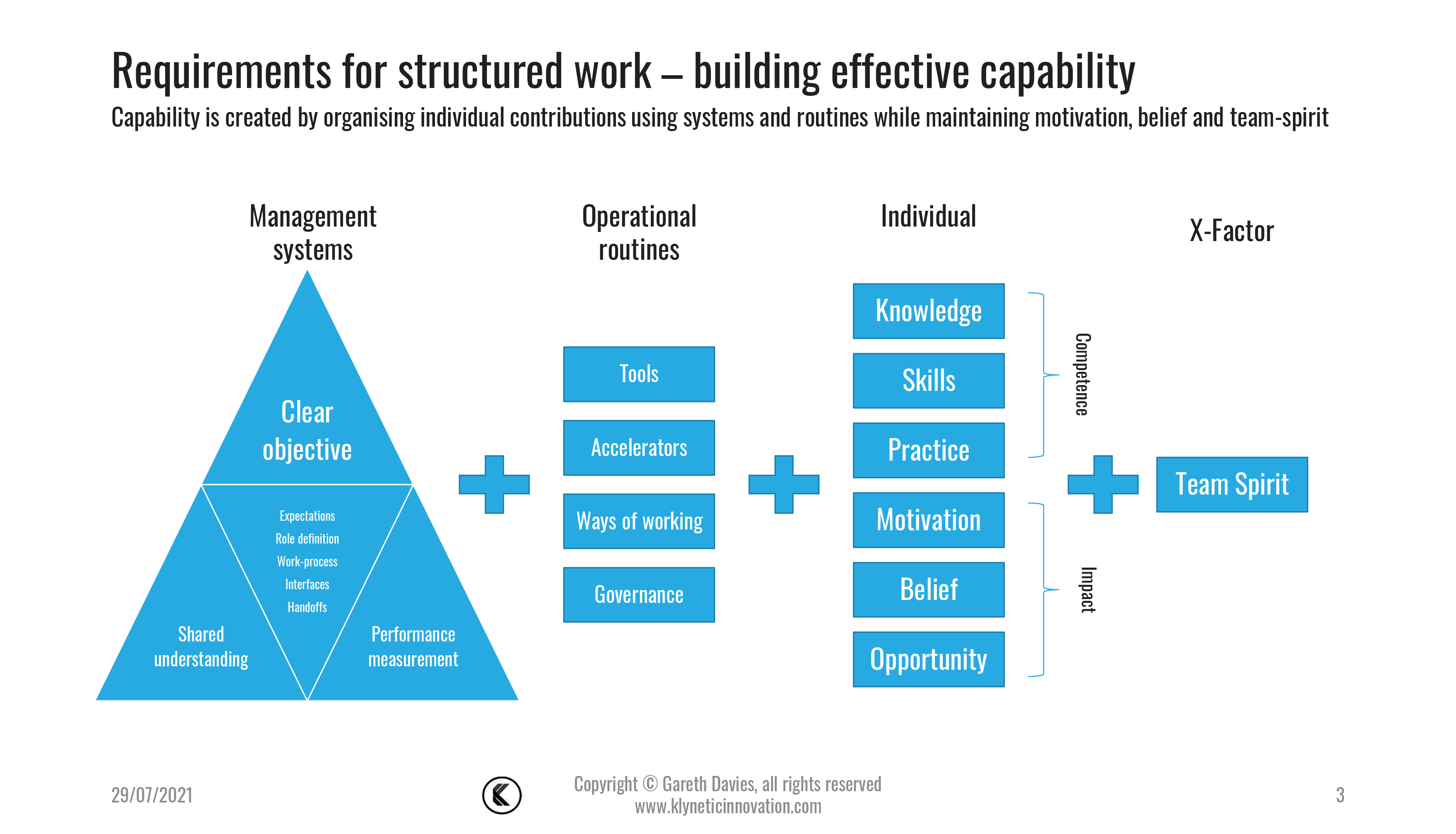
One of the approaches I’ve taken is to emphasise personal responsibility and progress-without-permission at lower levels in an organisation. Then to moderate this with the checks-and-balances of good governance provided by systems and oversight provided by graphics and shared language. I’ve coached people to recognise the differences between the competence displayed by an individual and the ability of management to co-ordinate work and form organisational capabilities.

It struck me that in the last thirty years we’ve been honing our ability to encourage leadership and peronal development while, perhaps, not paying enough attention to management. I use the diagram below as as a tool to discuss this topic with senior teams and help identify what’s missing.

I’d like to know your thoughts, please reach out and email me (or comment here).

It’s all about productivity

If you have followed this blog for a while you will know that, like a broken record, I have been banging on about digitalisation, the 4th Industrial Revolution and the productivity conundrum. I have often referred to Tim Harford’s article about electrification and how long it can take to make a transition.

Recently, I’ve started to add the “Energy Transition” into my thinking on the topic. The outcome remains the same but I keep finding more and more reasons why it will inevitably happen.

One of my go-to reads is Ian Stewart, Deloitte’s chief economist. If you’ve not signed up for his Monday briefing then you really should – it’s excellent. Today I have lifted most of his post (available here: https://blogs.deloitte.co.uk/mondaybriefing/2021/06/the-looming-capex-boom-.html) not only because I’m being lazy but also because it talks to many of the points I’ve been trying to communicate to my clients over the last 7 years (since I started Bestem).

Throughout history economies have been shaped by shocks, from recessions to technological shifts and energy transitions. The Great Depression helped change thinking about the role of government, paving the way for a permanent expansion in the state. The switch from steam power to electricity triggered a vast reorganisation of manufacturing.

The pandemic and the drive to net zero are similarly epoch-making events. The pandemic has driven technology adoption and changes in business practices. The energy transition involves an overall of energy production and distribution.

The structure of the economy will change. The sectoral balance of the economy, the skills needed, the uses of capital, the allocation of capital, will shift, creating winners and losers. It will also bring opportunities to rethink organisations, invest and raise productivity in ways that had not previously been considered viable or necessary.

The unlocking of the economy has unleashed a surge of pent-up demand into an economy operating with reduced capacity. That is creating inflation and bottlenecks, and incentivising investment. Meanwhile large corporates are flush with cash, capital is cheap and institutional investors want businesses to step up investment.

The global semiconductor shortage has spurred a flurry of investment announcements in new factories. Automakers are building new battery plants to meet demand for electric vehicles. Rising freight rates have prompted a surge in new orders for container vessels. And the move to ‘hybrid’ working and the growth of online shopping require a reconfiguration of office space and an ever- rising volume of warehouse capacity.

Labour costs play a role in investment decisions too. As countries emerge from lockdowns labour shortages have started to appear in sectors including manufacturing and construction. In the UK increases in the minimum wage continue to outstrip inflation, raising costs for firms and sectors reliant on lower-income work. An exodus of some 650,000 foreign-born workers from the UK last year, equivalent to 2.0% of the workforce, and a reduced flow of less skilled labour from the EU, create new pressures. More expensive and scarcer labour would sharpen incentives to invest in productivity-enhancing equipment and skills. Machines, for instance, could readily substitute for labour in washing cars and coffee preparation (I was in a motorway service station last weekend where the queue for Starbucks led me to get the same product from a self-service machine in the next-door Waitrose. I couldn’t tell the difference).

In the UK government policy has set out to boost investment with the capital-allowance ‘super-deduction’ targeted at plant and machinery. The Bank of England estimates that this will have its greatest effect in raising investment in some of the most capital-intensive sectors including manufacturing and transport.

A surge in private sector capital spending is likely to coincide with rising levels of public infrastructure investment, particularly related to ‘green’ projects. So, with private and public investment likely to grow, this recovery is looking very different from the one that followed the global financial crisis. Then UK business investment took six years to climb back to its 2008 peak. Today the Bank of England sees investment snapping back quickly, ending next year almost 10% above pre-pandemic levels. A similar story is likely to play out globally. Morgan Stanley believes that global investment will stand 20% above pre-pandemic levels at the end of 2022, a remarkable recovery from last year’s downturn.

This sort of surge in capex could help shift the dial on productivity, especially if, as seems likely, it is accompanied by organisational changes and the application of technology. (While business investment fell in the US and the UK last year, spending on IT and computers rose as firms investing in remote working and new ways of doing business.)

Much of the problem of poor productivity in the UK is concentrated in the long tail of medium- and smaller-sized businesses. The pandemic may, paradoxically, have had some positive effects here, as businesses of all sizes adapted and used new digital practices to weather the downturn.

One encouraging sign comes from the retail and administrative services sectors. Both sectors have registered strong productivity growth over the past decade, defying the characterisation of these as labour-intensive, low-productivity parts of the economy. Online shopping, self-service and use of IT in administrative tasks seem to have played a big role. It may be that other labour-intensive sectors, such as healthcare and education, might in time achieve similar gains in productivity.

It won’t be plain sailing. In some important respects the pandemic and the energy transition could act as a drag on productivity. It’s not, for instance, clear how significantly increased levels of homeworking will affect productivity. A recent study of a large Asian tech company found that increased communication and coordination costs more than offset gains from reduced commuting times and reduced overall productivity . Ben Broadbent, a member of the Bank of England’s Monetary Policy Committee, cautions that lower use of offices and transport infrastructure imply a less productive use of the capital stock . Nor is capital spending rising everywhere. Some fossil fuel companies and airlines are cutting capex in anticipation of lasting weaker demand. Structural shifts in the economy risk creating mismatches between supply of and demand for labour. The interruption to education and rising youth unemployment could leave lasting scars.

The pandemic and the energy transition represent the greatest structural change since the shift to electrification and the Great Depression in the inter-war period. The question is how these changes can be harnessed to build a better future. The years after the financial crisis were marked by weak investment, productivity and wage growth. We should be able to do better this time

Here are a selection of earlier articles that talk to the same themes.

How’s your Covid score card?

Today the FT ran a story about food inflation. They said:

“Global food prices surged by the biggest margin in a decade in May as one closely-watched index jumped 40 per cent in the latest sign of rising food inflation.”

https://www.ft.com/content/8b5f4b4d-cbf8-4269-af2c-c94063197bbb

15 months ago we flagged that possibility. Mark, Ken and I sat down to collate the findings from our network and to analyse it through our innovation and transformation frameworks. We not only had some sound advice on what approaches could be considered, but also we threw in some “wild-cards”.

Corporate debt overhang will need to be erased before growth emerges – that may be through default, forgiveness or increased inflation. The availability, cost and impact of capital may be unlike anything experienced by today’s finance professionals. Long term mass-unemployment may result from the disruption to our daily lives and lead to political pressure to change the order of beneficiaries from the production of wealth from the application of capital.

It wasn’t universal of course – we also suggested that house prices might crash. I think the government thought that too, because they suspended property purchase tax to stimulate the market. We were wrong, we didn’t expect that thousands of people would want to leave cities and drive up the price of properties with outside space. Though it’s not over yet…..

Why not read the report again (it’s short) it would be great to hear your take on our other advice – where did we nail it, and where did we miss? Alternatively you can also read the much more extensive book “Responding to Crisis, a Leader’s handbook” available from amazon here:

Energy Transition is a horizontal technology.

Until today I thought energy transition was a consequence of the fourth industrial revolution. Now I am convinced it is fundamental driver of change.

I have been an advocate of digitalization being at the heart of the fourth industrial revolution for a few years now. One of the reasons for it is that it is a “horizontal technology”. It is called this because it affects many other industries. Farming gets better, industrial processes get better and (when they get self-driving to work) others, like taxi driving, cease to exist. While I still think digitalisation is at the core, I don’t think it stands alone.

I am a gen-Xer and, 5-10 years ago, I started to notice there was a lack of interest in careers in engineering of fossil fuels from new entrants. I blamed that on all the old folks in grey suits not listening to new hip ways to be digital. While the ignorant old men rejecting digitalisation (and pooh-poohing new ways to work) was definitely correlated I’m no longer sure it was causal.

When I went to the energy sessions at London tech week, no one was talking oil and gas. No one. Not a single fossil fuel company was present. It was all renewables, smart grids, energy efficiency. Now I know why.

Energy transition – and in a broader sense decarbonisation – affects every industry. In the same way that digitalisation is not doing business the same way and just replacing paper with computers, energy transition is not about going about life in the same way and just changing the fuel used.

Today I watched this remarkable video by my friend Rob West who has been in the Bestem Network for a few years now.

It also looks like Rob might think that video is a new skill that’s going to be required to function in the commercial world soon. I do.

Not only has he provided me with a light-bulb moment around energy transition, but also he explained the dilemma of being true to your metier while trying to get people to pay you to do more of what you think is important work. In a way he also shows how digitalisation allows businesses to be more specialised and to reward those who know what they are talking about rather than just those that can harness the power of others. That’s how I intend to run Klynetic Innovation.

Good work Rob, keep it up!